A Community of Practice for the people rebuilding how learning works across Greater Philadelphia and New Jersey.
Leaders Learn Better When They Learn With and From Each Other
The central value of the Hub is the creation of an ongoing Community of Practice in which leaders working within the same field can learn with and from one another.
Traditional professional development frequently assumes that expertise flows from an expert to a participant. The Hub model recognizes another important source of expertise: the accumulated experience of peers who are confronting similar challenges in different organizations and communities. Research supports this approach. Vescio, Ross, and Adams' review of research on professional learning communities examined 11 studies and concluded that well-developed professional learning communities can positively affect professional practice and, importantly, student learning. Their findings emphasize the value of sustained collaboration, collective learning, reflection on practice, and professionals learning from one another rather than relying exclusively on isolated training.
The objective is therefore not simply networking. It is to create a trusted learning community where leaders can:
share models and practices that are producing results;
examine what worked, what did not, and why;
troubleshoot common implementation challenges;
identify practices that may be transferable across organizations or communities;
develop partnerships and collaborative initiatives; and
convert frontline experience into knowledge that can influence the broader field.
A Community of Education Innovators
The Education Hub brings together identified leaders from the Greater Philadelphia and New Jersey Social Innovation Awards whose work demonstrates promising approaches to improving education, opportunity, and outcomes for children, youth, families, and communities.
The Social Innovation Awards use public nominations and regional review to identify the leading social innovators and changemakers, including leaders advancing education entrepreneurship and other interconnected social challenges. Rather than creating another network based primarily on organizational size, title, or institutional affiliation, the Education Hub begins with identifying the leading changemakers who are having community impact.
The Education HUB by uniting them creates a distinctive community: practitioners learning from practitioners—leaders who are actively designing, implementing, testing, and refining solutions in real communities.
Facilitated Communities of Practice
Michael Golden of Penn GSE will serve as moderator, facilitating peer learning, surfacing promising practices, connecting participants around common challenges, and helping translate practitioner experience into knowledge that can benefit the broader field.
At each of the six Institute convenings, participants will engage in both cross-sector leadership development and Education Hub Learning—creating leadership breadth while preserving the industry depth that makes peer learning valuable.
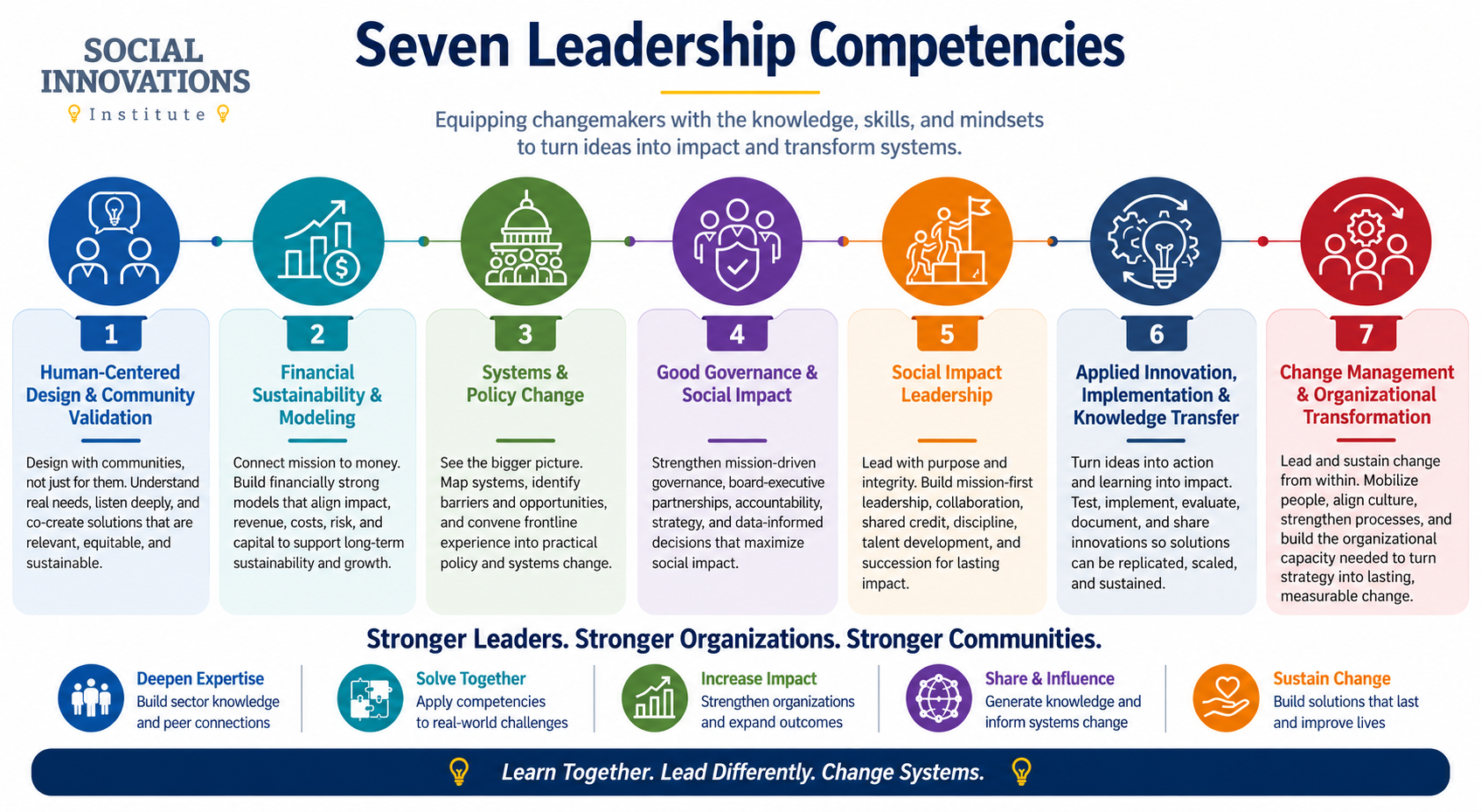
Leadership development is focused on developing seven core competencies: Human-Centered Design & Community Validation • Financial Sustainability & Modeling • Systems & Policy Change • Good Governance & Social Impact • Social Impact Leadership • Applied Innovation, Implementation & Knowledge Transfer • Change Management and Organizational Transformation.
Education Hub Learning is focused on participants developing share models and practices to learn with and from one another and identify innovations worthy of broader dissemination. Selected practices will be developed into practitioner-driven case studies for publication in the Social Innovations Journal