
The Social Innovations Institute creates Learning Hubs that brings together social innovators, community leaders, practitioners, entrepreneurs, funders, researchers, and policymakers to strengthen the ideas, organizations, and leaders driving social change. The Institute is built around a simple premise: lasting social impact requires both deep knowledge of the issues and strong leadership capabilities to move solutions from ideas to implementation, sustainability, scale, and systems change.
Participants learn through two interconnected experiences: Communities of Practice/Learning Hubs, where leaders working on similar challenges learn from one another, and Leadership Competencies, which build the capabilities needed to lead effective and sustainable social innovation. Participants move from: Community Challenge → Ideas → Innovation → Implementation → Evidence → Sustainability → Scale → Systems & Policy Change
The Institute is not designed as a traditional training program. At each convening, participants learn together across sectors, then work within their Communities of Practice to apply those leadership competencies to the challenges they encounter every day. This structure creates both industry depth and a shared leadership language across the Institute.
Learning is ultimately translated into action. Participants exchange models, troubleshoot implementation challenges, document promising practices, develop case studies, identify policy barriers and opportunities, and connect effective innovations with partners and capital.
Focus Areas & Communities of Practice
The Social Innovations Institute brings together leaders through five Communities of Practice focused on critical social challenges and three Population Groups representing people and communities whose experiences cut across these systems.
This structure recognizes that social challenges do not exist in isolation. Education connects to workforce opportunity; housing influences health; food access affects individual and family well-being; and each of these systems must respond effectively to the needs of diverse populations.
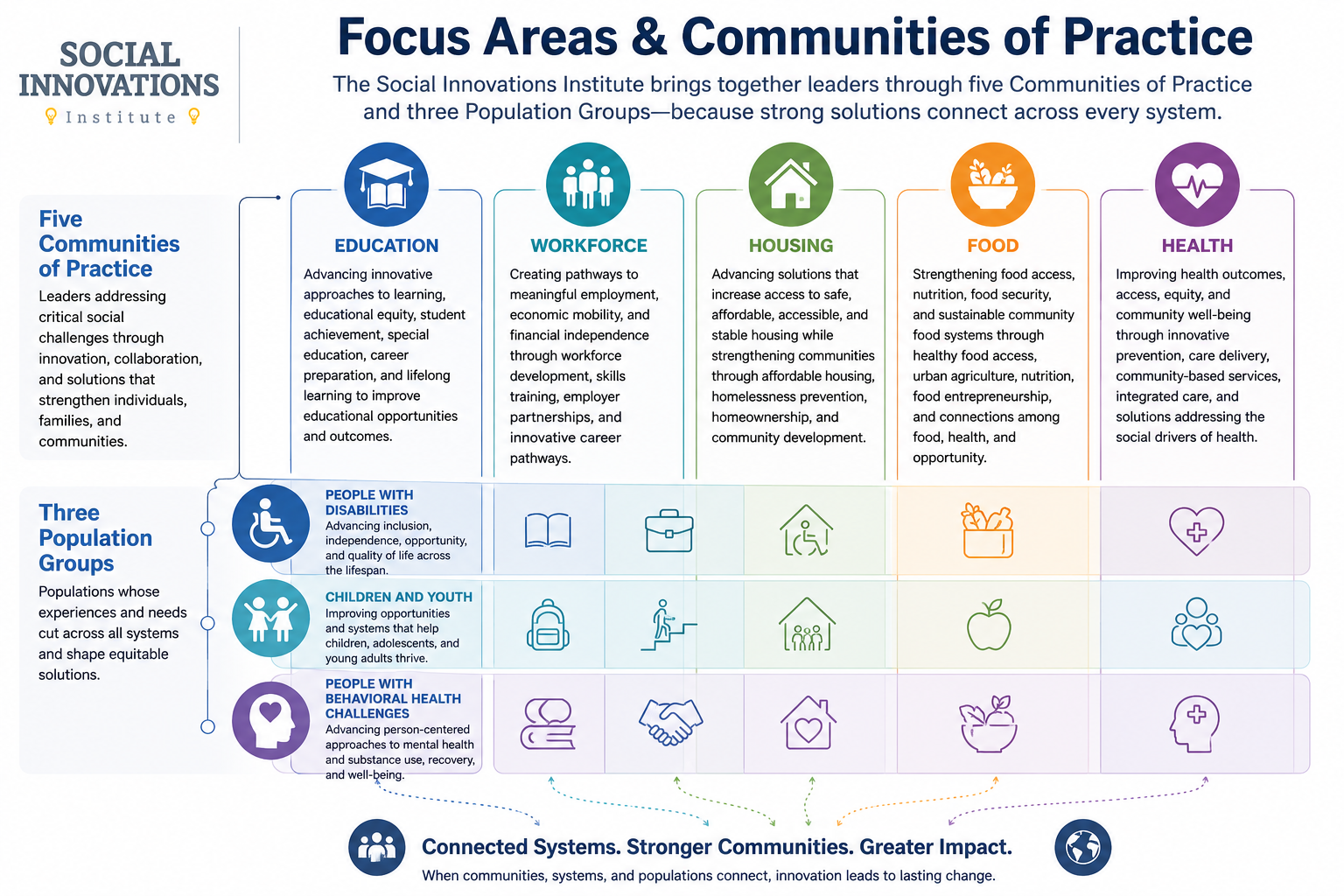
Communities of Practice
Education: Advancing innovative approaches to learning, educational equity, student achievement, special education, career preparation, and lifelong learning. The Education Community of Practice connects educators, community organizations, policymakers, funders, and innovators working to improve educational opportunities and outcomes.
Workforce: Creating pathways to meaningful employment, economic mobility, and financial independence. The Workforce Community of Practice explores adult and youth workforce development, career-connected learning, skills development, employer partnerships, entrepreneurship, workforce access, and innovative approaches to connecting people with sustainable careers.
Housing: Advancing solutions that increase access to safe, affordable, accessible, and stable housing while strengthening communities. The Housing Community of Practice addresses affordable housing, homelessness prevention, supportive housing, neighborhood revitalization, homeownership, and community development.
Food: Strengthening food access, nutrition, food security, and sustainable community food systems. The Food Community of Practice brings together leaders working in areas including healthy food access, community-based food systems, urban agriculture, nutrition, food entrepreneurship, and the connections among food, health, community, and economic opportunity.
Health: Improving health outcomes, access, equity, and community well-being through innovative models of prevention, care delivery, community-based services, integrated care, and solutions addressing the social drivers of health. The Health Community of Practice connects healthcare with the broader systems and community conditions that influence health and well-being.
Population Groups
Across the five Communities of Practice, the Institute places particular emphasis on three populations that frequently interact with multiple education, workforce, housing, food, health, and human-service systems.
People with Disabilities: Advancing inclusion, independence, opportunity, and quality of life for people with intellectual, developmental, physical, behavioral, and other disabilities. This population group examines how systems can become more accessible, person-centered, integrated, and responsive across the lifespan.
Children and Youth: Improving the opportunities and systems that enable children, adolescents, and young adults to thrive. Areas of focus include education, health and well-being, family and community supports, youth development, career pathways, transition to adulthood, and the conditions that contribute to long-term success.
People with Behavioral Health Challenges: Advancing community-based, person-centered approaches for people experiencing mental health and substance use challenges. This population group explores prevention, early intervention, treatment, recovery, integrated care, workforce needs, community supports, and the intersection of behavioral health with housing, education, employment, food access, and physical health.
Leadership Competencies
Across every focus area, Institute participants develop a common set of leadership competencies designed to move social innovation from promising ideas to sustainable impact.
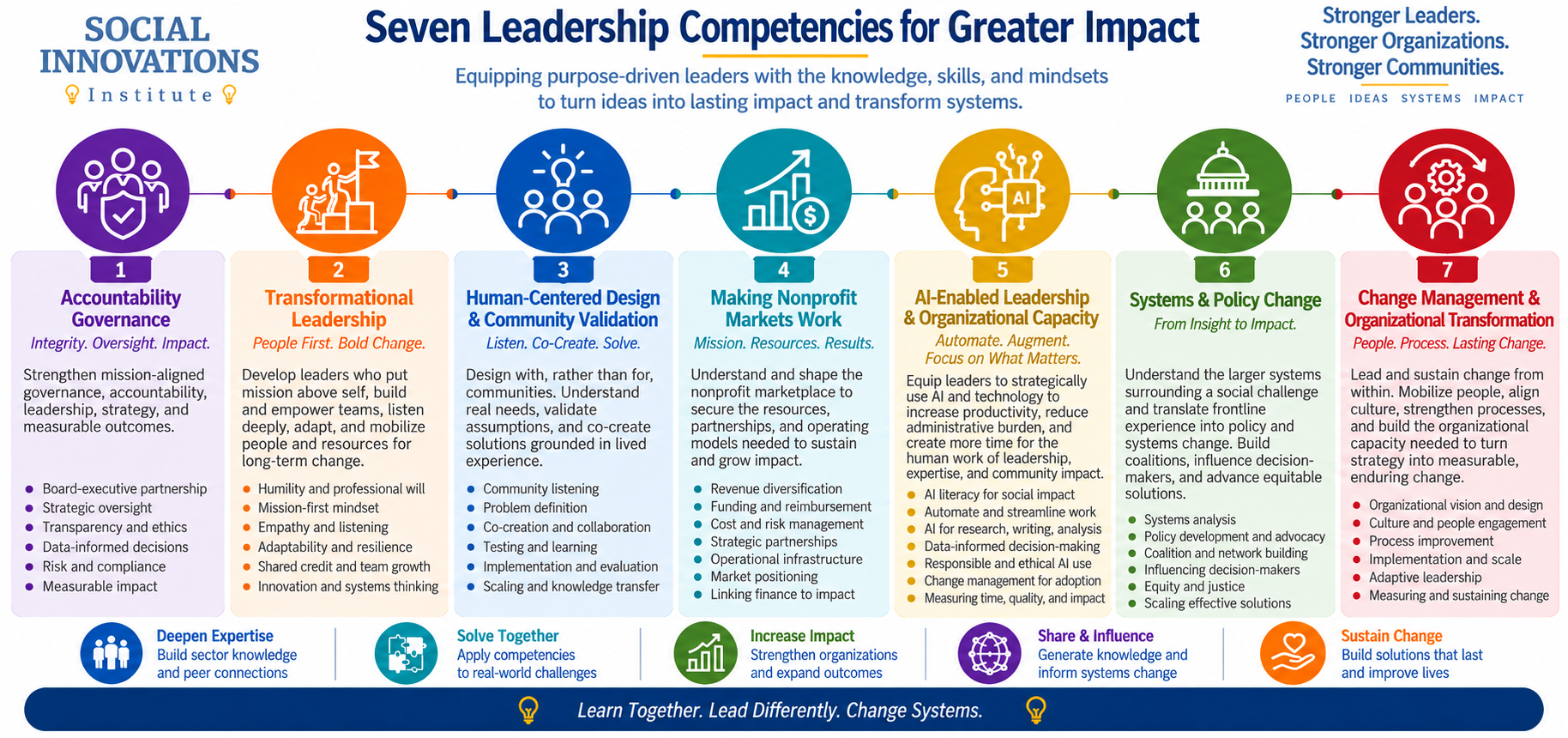
Accountability Governance: Strengthen mission-aligned governance, accountability, leadership, strategy, and measurable outcomes. Leaders learn to build effective board-executive partnerships, clarify decision rights and responsibilities, establish transparent performance expectations, use data for oversight and continuous improvement, and create a culture of ethical stewardship in which resources, decisions, and results remain visibly connected to mission and community impact.
Transformational Leadership: Develop leaders who combine humility and professional resolve with the opportunity-seeking, adaptive, and mission-driven characteristics of social entrepreneurs. Transformational leaders put the mission above personal recognition, build and empower strong teams, listen deeply, confront difficult realities, self-correct, share credit, persist through setbacks, cross disciplinary boundaries, and mobilize people and resources around meaningful long-term change.
Human-Centered Design & Community Validation: Design with, rather than simply for, communities. Leaders learn to understand problems from the perspective of those most affected, listen deeply, validate assumptions, identify real needs and assets, and co-create solutions grounded in lived experience. Leaders also learn to prototype, test, implement, document, evaluate, and refine solutions so promising ideas can become sustained and transferable practices.
Making Nonprofit Markets Work: Understand and shape the nonprofit marketplace so mission-driven organizations can secure the resources, partnerships, operating models, and revenue needed to sustain and grow impact. Participants connect mission to money by examining revenue diversification, pricing and reimbursement, philanthropy, public funding, earned income, partnerships, cost structures, risk, capital, infrastructure, and the competitive and collaborative dynamics that influence whether strong organizations can thrive.
AI-Enabled Leadership & Organizational Capacity: Use AI, technology, and automation to reduce administrative burden and expand the time leaders and professionals can devote to mission-critical work. Participants learn to automate and augment routine tasks, improve workflows, strengthen research, analysis and decision-making, and responsibly use AI so people can focus their time on the expertise, relationships, creativity, judgment, community engagement, and leadership that create social impact.
Systems & Policy Change: Understand the larger systems surrounding a social challenge and translate frontline experience into opportunities for policy and systems change. Leaders learn to map systems, identify structural barriers and leverage points, build coalitions, engage decision-makers, develop policy propositions, and use data, lived experience, and implementation evidence to influence funding, regulation, practice, and public policy.
Change Management & Organizational Transformation: Lead and sustain change from within. This competency focuses on aligning leaders and staff around a shared vision, building readiness and ownership, strengthening organizational culture and processes, redesigning structures and workflows, developing talent, communicating consistently, and using data to manage implementation. Leaders learn to move strategy from concept to adoption so new ways of working become embedded, measurable, and sustainable.
Learning Hubs: Communities of Practice & Population Groups
The Social Innovations Institute runs six three-hour sessions from February through October 2027. Each pairs leadership development across seven core competencies with a Learning Hub in the participant’s own field. What the Hubs surface becomes practitioner case studies in the Social Innovations Journal and policy briefs presented to county health and human services leadership. Select an option to see what it includes.
Your sponsorship
Select a level above to see it here.
Institute places and partnerships are arranged directly, by invoice or grant agreement.
Questions, or want to pay by check or invoice? Email nick@socialinnovationspartners.org.
